About us
Our Storie
Our Emblem
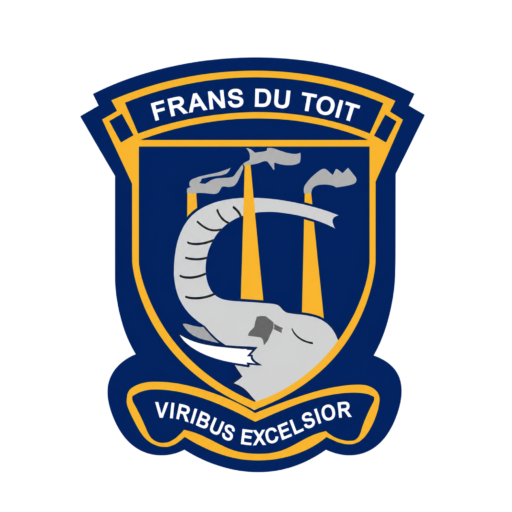
Aan die begin van 1967 is ’n kompetisie van stapel gestuur vir die ontwerp van ’n skoollied en embleem vir Hoërskool Frans du Toit. Daar is uiteindelik besluit om ’n sakembleem te gebruik wat deur Frieda van den Berg ontwerp en ingedien is.
Ons skoolwapen bevat drie groot skoorstene, een van Phalaborwa se bekende bakens, asook ’n olifant wat triomfantlik sy slurp lig. Saam simboliseer hierdie elemente die leuse: “Kragtig Hoër.” Die Latynse vertaling van die leuse, soos deur prof. C.P.F. Naudé van UNISA vasgestel, is VIRIBUS EXCELSIOR.
Aangesien ons skool ’n parallelmediumskool is, is daar besluit om slegs die Latynse weergawe van die leuse te gebruik. Die heraldiese ontwerp verteenwoordig ook die mynbedryf, wat ’n belangrike rol in die ontstaan van ons skool gespeel het, asook die natuurlike omgewing waarvan ons deel vorm.
At the beginning of 1967, a competition was launched for the creation of a school song and emblem for Frans du Toit High School. Eventually, it was decided to use a pocket emblem designed and submitted by Frieda van den Berg.
Our badge features three large chimneys, one of the well-known landmarks of Phalaborwa, as well as an elephant triumphantly lifting its trunk. Together, these elements symbolise the motto: “Forcefully Higher.” The Latin translation of the motto, as formulated by Prof. C.P.F. Naudé of UNISA, is VIRIBUS EXCELSIOR.
As our school is a parallel-medium school, it was decided to use only the Latin version of the motto. The heraldic design also represents the mining industry, which played an important role in the establishment of our school, as well as the natural environment of which we form part.
The School song
The school song was first introduced in 1968, the following year. It was written in Afrikaans by a former matric learner, Corrie Terlouw, and set to music by a teacher, Miss H.M. van Biljon, better known as “Tannie Magda” from the then-popular children’s television series Wielie Walie.
The school song was sung for the first time during an assembly on 2 February 1968.
Die skoollied het die daaropvolgende jaar, in 1968, ontstaan. Dit is in Afrikaans geskryf deur ’n voormalige matriekleerling, Corrie Terlouw, en getoonset deur ’n onderwyseres, mej. H.M. van Biljon, beter bekend as “Tannie Magda” van die destyds gewilde kindertelevisiereeks Wielie Walie.
Die skoollied is op 2 Februarie 1968 vir die eerste keer tydens ’n saalbyeenkoms gesing.
More about out history
Phalaborwa was een van die opwindendste ontwikkelings in Afrika. Vanuit ’n versigtige begin het dit ontwikkel tot ’n enorme myn-, metallurgiese en chemiese kompleks met skynbaar onbeperkte reserwes van fosfate, yster, koper, uraan, sirkonium, potas en aluminium.” Dit is die woorde van dr. J.P. Kearny, ’n voormalige voorsitter van die Phosphate Development Corporation.
Hierdie geweldige myn- en nywerheidskompleks, wat binne 36 jaar tot ’n reus gegroei het, sou nie moontlik gewees het sonder die belegging in kundigheid en denkrag wat die talle briljante wetenskaplikes, administrateurs en tegnici voorsien het wat noodsaaklik was vir so ’n groot onderneming nie. Die skatte onder ons dorp sou steeds diep onder die grond gelê het as dit nie vir hierdie belegging was nie — ’n klein belegging in geldelike terme, maar een waarvan die wins en opbrengs nie in geld gemeet kan word nie.
Die ontwaakte reus het gou die behoefte aan onderwys besef. Die eerste laerskool in Phalaborwa, die “Vermikulietskool”, het met 17 leerders geopen en is in 1951 gestig. Teen die einde van 1965 het dié skool, wat as Laerskool Phalaborwa bekend gestaan het, uit sy nate gebars. In 1966 is Fauna Park Primary gestig en het ’n hoërskool noodsaaklik geword. Op 17 Januarie 1966 is 12 personeellede en mnr. I.D. van der Walt as tydelike skoolhoof aangestel om die stigting van Hoërskool Frans du Toit aan die gang te sit.
Die personeel en leerders het vir ’n tyd lank die nuwe geboue van Fauna Park Primary gebruik. Op 7 Maart het die personeel en leerders na die nuwe hoërskoolgebou verskuif en teen die einde van die eerste kwartaal, op 1 April 1966, kon die skool met ’n inskrywing van 225 leerders spog en was dit goed op dreef. Vandag het ons meer as ’n duisend leerders.
Phalaborwa was one of the most exciting developments in Africa. From a cautious beginning it has developed into an immense mining, metallurgic and chemical complex with seemingly unlimited reserves of phosphates, iron, copper, uranium, zirconium, potash and aluminium.” These are the words of Dr J.P. Kearny, a former chairman of the Phosphate Development Corporation.
This tremendous complex of mining and industry, which has grown into a giant in 36 years, would not have been possible had it not been for the investment in brainpower which ensured the many clever scientists, administrators and technicians who were essential to such a huge undertaking. The treasure under our town would still be lying deep under the ground if it had not been for this investment — a small investment in monetary terms, but one of which the profits and dividends cannot be estimated in terms of money.
The awakened giant quickly realised the needs of education. The first primary school in Phalaborwa, the “Vermikulietskool”, had an enrolment of 17 pupils and was started in 1951. By the end of 1965, this school, known as Laerskool Phalaborwa, was bursting at the seams. In 1966, Fauna Park Primary was started and a high school became essential. On 17 January 1966, 12 members of staff and Mr I.D. van der Walt as temporary principal were appointed to set the wheels in motion to found Frans du Toit High School.
For a time, the staff and pupils occupied the new Fauna Park Primary School buildings. On 7 March, the staff and pupils moved into the new high school building and, at the end of the first term on 1 April 1966, the school could boast an enrolment of 225 and was well on its way. Today, we have over a thousand learners.
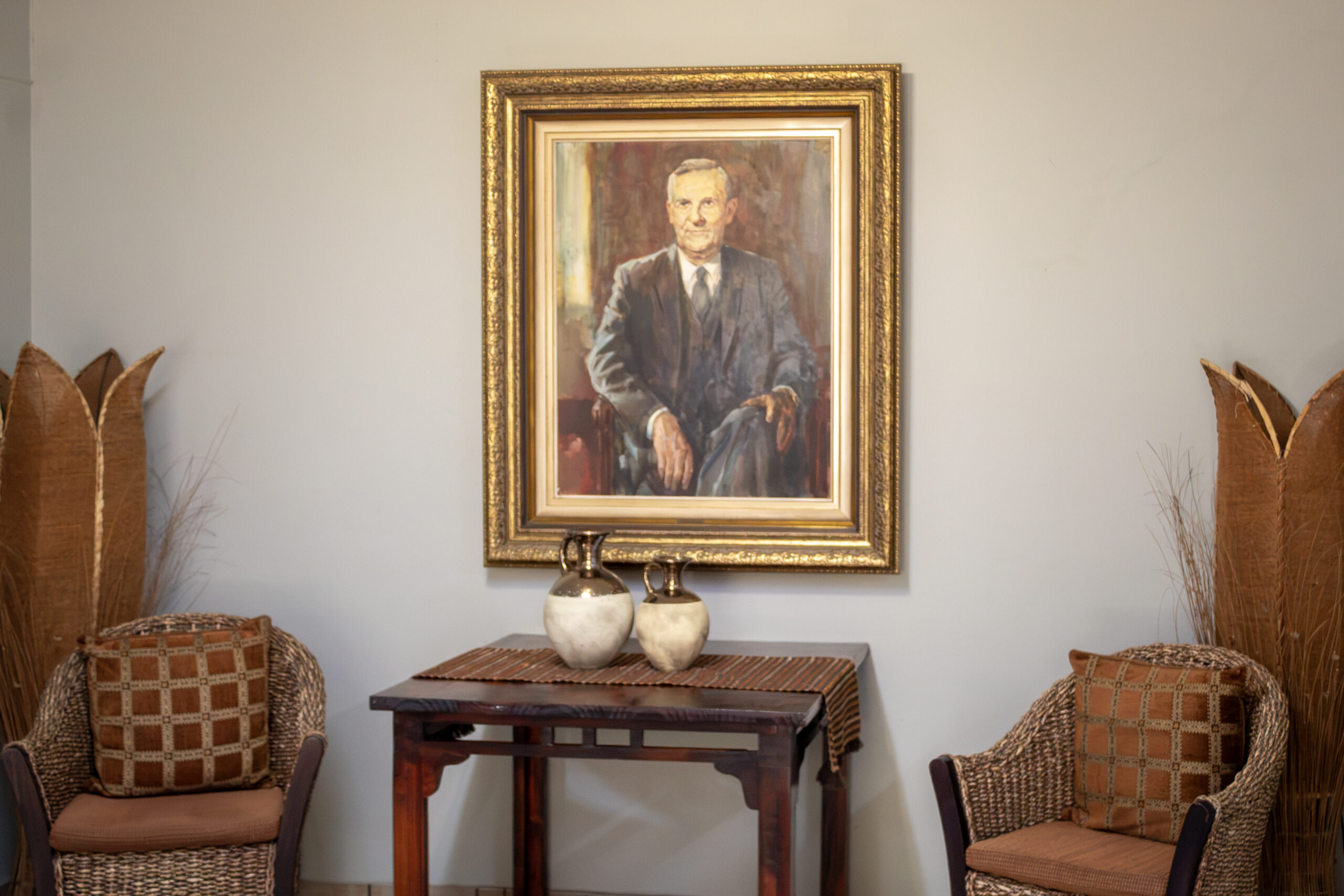
Who was Dr. Frans du Toit?
Dr Francois Jacobus du Toit is in 1897 op die plaas Caroluspoort in die Colesberg-distrik gebore. Alhoewel hy sy hele lewe lank ’n groot liefde vir die plaaslewe gehad het, het sy loopbaan hom in ’n ander rigting geneem, waar hy ’n blywende bydrae tot Suid-Afrika se ekonomiese en nywerheidsontwikkeling gelewer het.
Dr du Toit was die professionele adviseur van die destydse Minister van Ekonomiese Sake, mnr. Eric Louw. Hy was ook die Voorsitter van die Tussentydse Komitee en het die afvaardiging gelei wat op 24 April 1951 met dr. H. Merensky vergader het om die toekoms van fosfaatproduksie in Suid-Afrika te bespreek.
As Foskor se eerste Voorsitter het dr. du Toit die maatskappy deur sy moeilike beginjare gelei. Sy leierskap het gehelp om verskeie vroeë uitdagings op te los en Foskor op die regte pad geplaas om die nywerheidsreus te word wat dit vandag is.
Dr. du Toit is op 17 Maart 1961 in Bangkok oorlede, waarna dr. van Eck as Voorsitter van Foskor oorgeneem het. Hy was bekend as ’n energieke, vasberade en doelgerigte persoon wat hom nooit deur struikelblokke laat afskrik het nie. Sy lewensresep vir sukses bly vandag steeds relevant:
“Hard work opens the door to success. Put your work above self-concern. Be always well-prepared and well aware of facts.”
Hoërskool Frans du Toit dra sy naam met trots en staan as ’n blywende huldeblyk aan die besondere bydrae wat “Oom Frans” tot ons land se mense, nywerheid en jeug gelewer het.
Dr Francois Jacobus du Toit was born in 1897 on the farm Caroluspoort in the Colesberg district. Although he had a lifelong love for farming, his career took him in a different direction, where he made a lasting contribution to South Africa’s economic and industrial development.
Dr du Toit served as professional adviser to the then Minister of Economic Affairs, Mr Eric Louw. He was also Chairman of the Interim Committee and led the delegation that met with Dr H. Merensky on 24 April 1951 to discuss the future of phosphate production in South Africa.
As Foskor’s first Chairman, Dr du Toit guided the company through its challenging formative years. His leadership helped resolve many of its early difficulties and placed the organisation on a path toward becoming the industrial leader it is today.
Dr du Toit passed away in Bangkok on 17 March 1961, after which Dr van Eck became Chairman of Foskor. Known for his energy, determination and perseverance, Dr du Toit was never discouraged by obstacles. His philosophy for success remains meaningful today:
“Hard work opens the door to success. Put your work above self-concern. Be always well-prepared and well aware of facts.”
Frans du Toit High School proudly bears his name and stands as a lasting tribute to the remarkable contribution “Oom Frans” made to the people, industry and youth of South Africa.
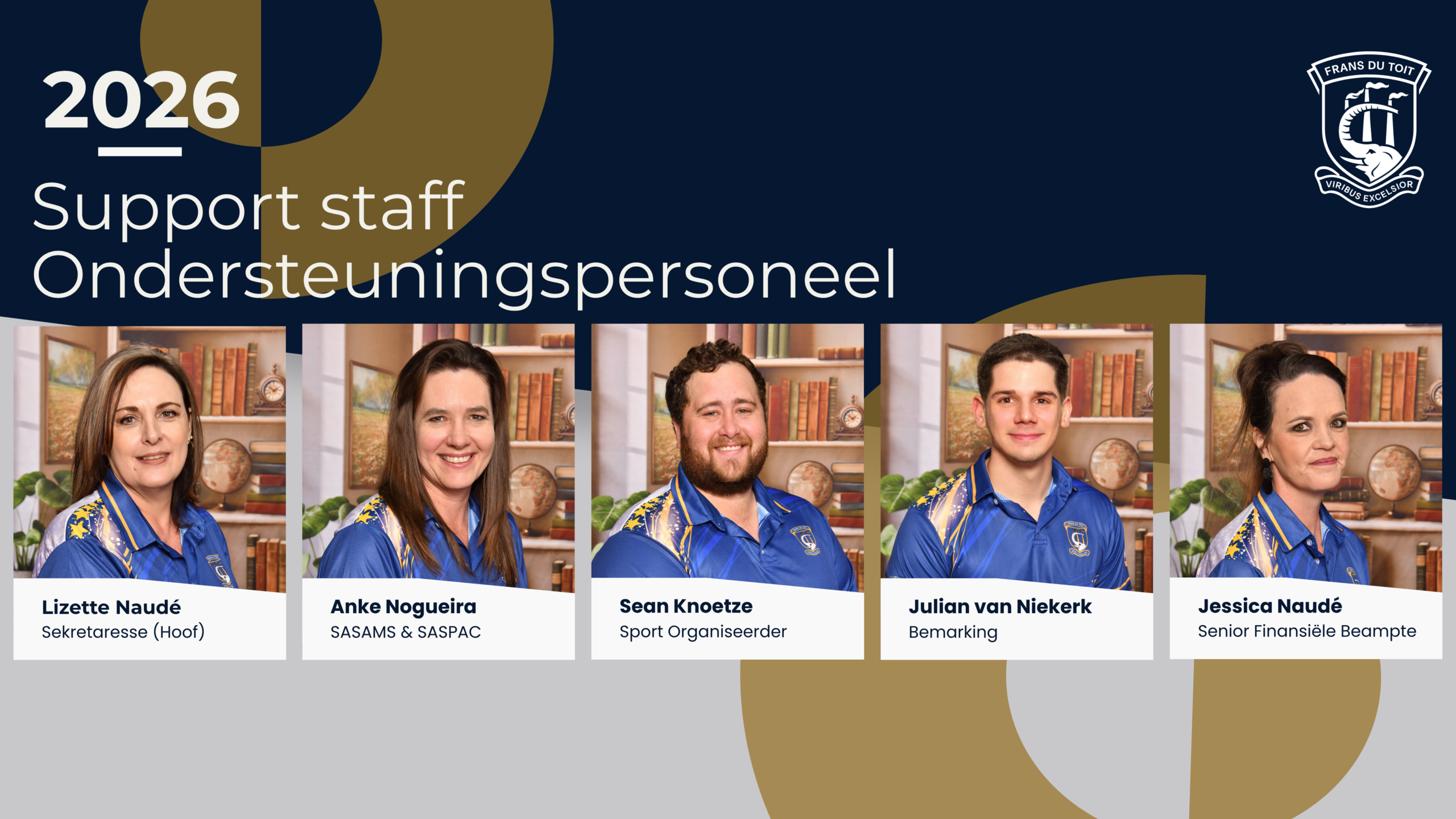
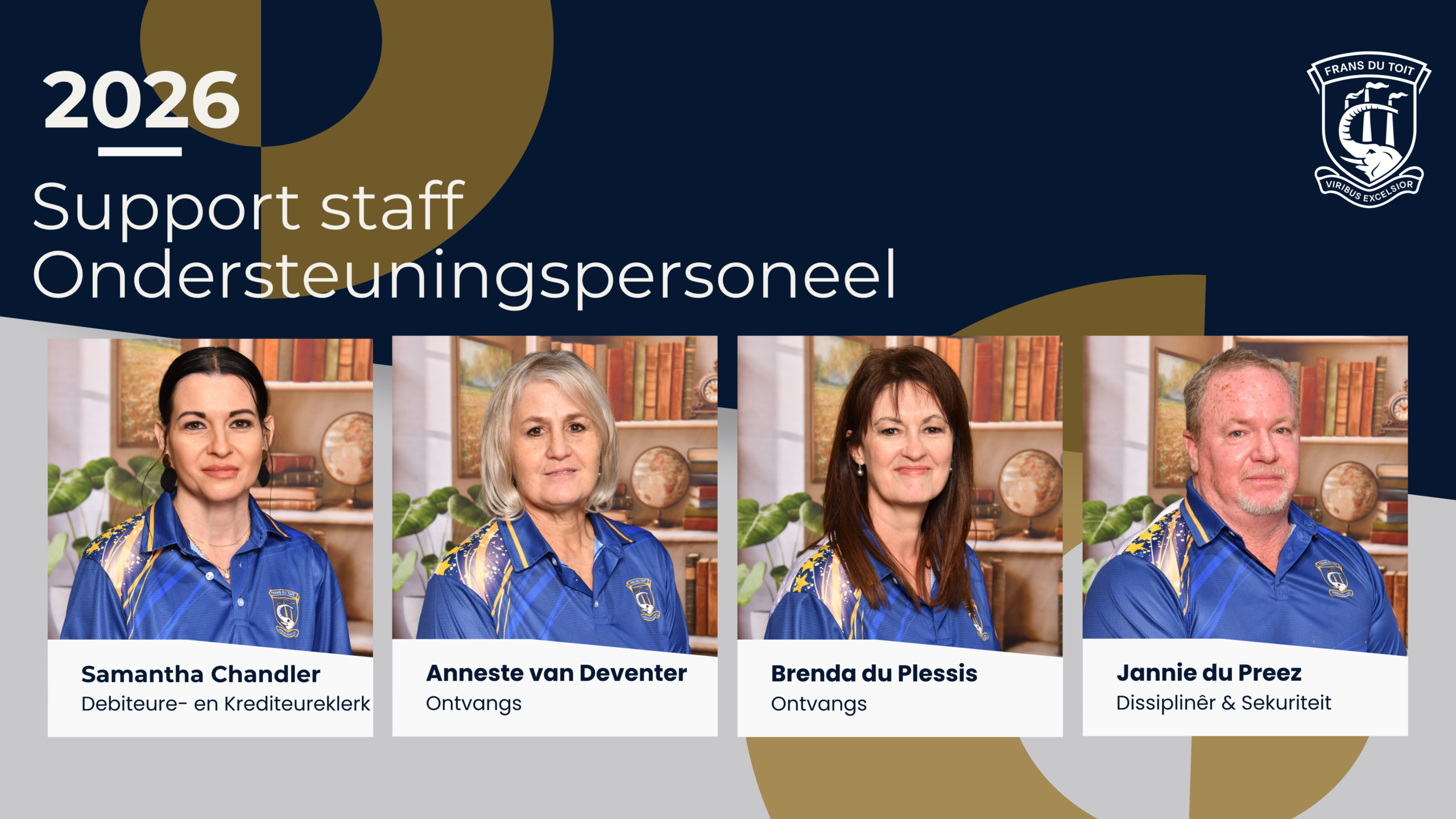
Our Support Staff
Ons Ondersteuningspersoneel